









Virtual reality in education is one of the fastest-growing and most discussed technologies in the EdTech sector. VR technologies in education transform static learning materials into an interactive, immersive environment where students do not just read about processes but fully engage with them, simulate situations, and practice skills in a safe digital space. This article provides an in-depth expert analysis: how VR works in education, its effectiveness, benefits, limitations, and how to choose the right technology.
What VR in Education Is and How It Works
VR in education refers to the use of virtual reality systems (headsets, controllers, trackers, and specialized software) to create a three-dimensional immersive learning environment.
Key elements:
- Hardware: VR headsets (standalone and PC-based), controllers, peripherals
- Software: educational apps, simulators, content creation platforms
- Methodology: lesson design, assessment, curriculum integration
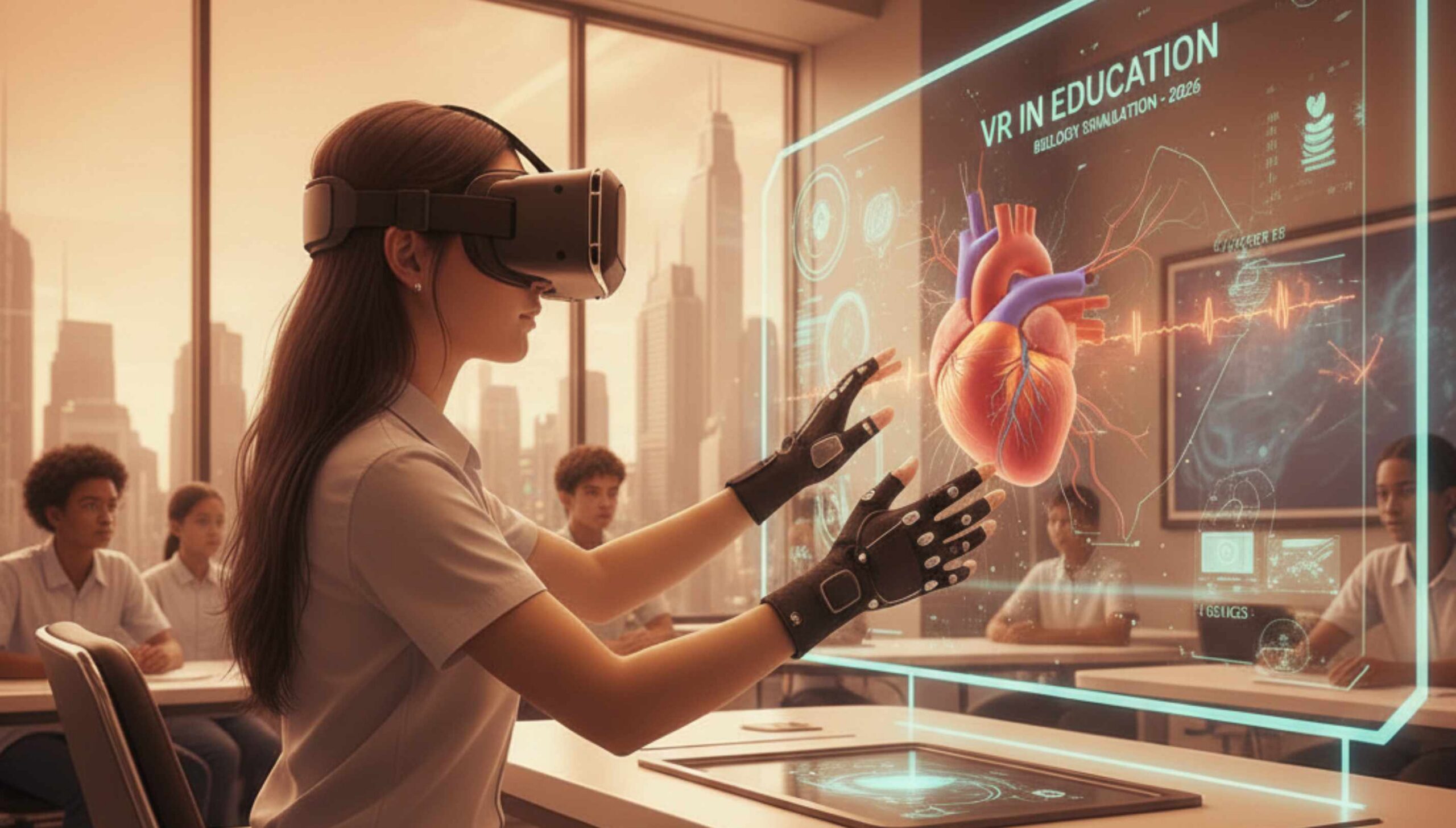
Instead of passive perception, VR provides immersion: the student appears inside the model (anatomical, historical, laboratory), interacts with digital objects, runs simulations, makes decisions, and receives immediate feedback.
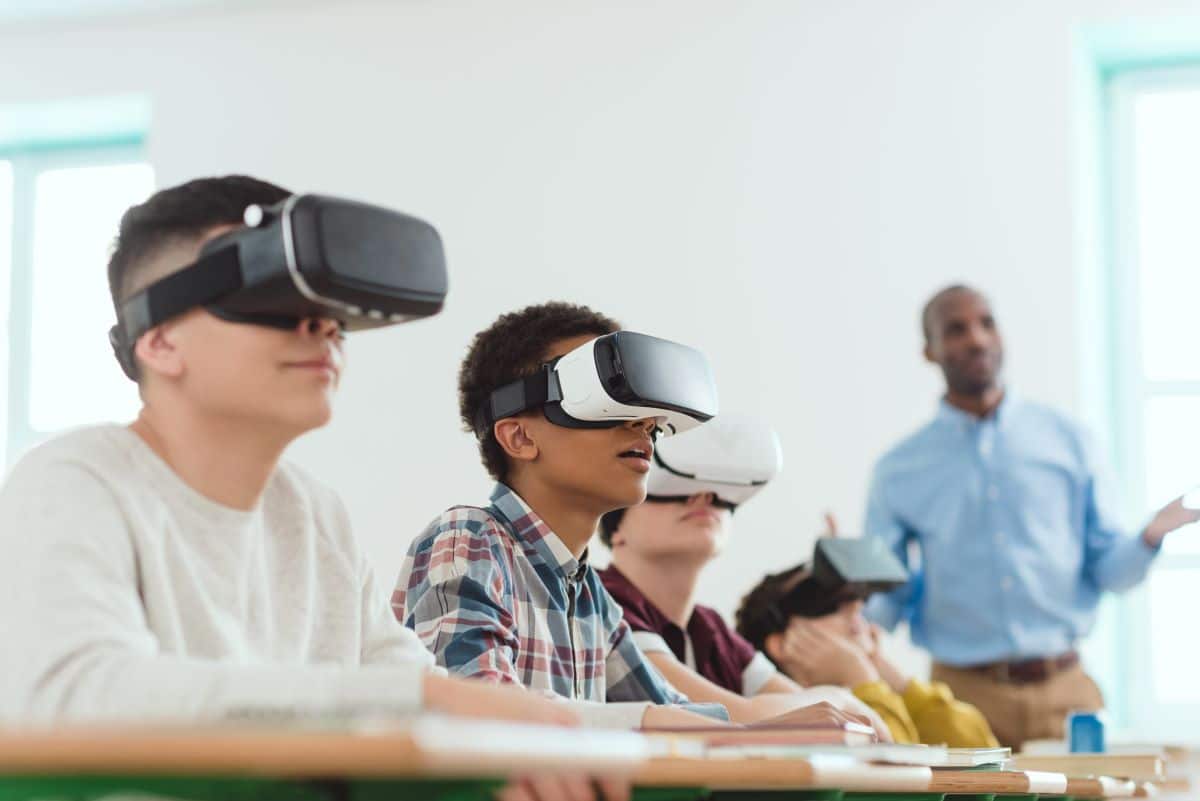
Key Advantages of Virtual Reality in Education
Immersive learning
Full engagement reduces distractions and improves focus. Students experience phenomena, not just read about them.
Interactivity and hands-on modelling
VR enables learners not only to observe, but to manipulate objects, assemble mechanisms, perform experiments, and practice medical procedures.
Safety and resource efficiency
Dangerous or costly experiments can be fully simulated.
Personalized learning
Lessons adapt to individual pace and style.
Improved cognitive perception and memory
Multisensory learning increases long-term retention.
Motivation and engagement
Gamified VR scenes boost interest and consistency.
Access to unique environments
Virtual field trips, historical reconstructions, cosmic journeys – all become accessible to any student.
Comparison Table: Traditional Learning vs VR in Education
| Criterion | Traditional Learning | VR in Education |
| Engagement | Medium | High |
| Practical skill training | Limited (labs, simulators) | Extensive (simulations, repeated practice) |
| Safety | Risks during complex experiments | Safe simulations |
| Deployment cost | Low/medium (depends on equipment) | High at the initial stage, lower long term |
| Personalization | Often limited | High (adaptive scenarios) |
| Multimodal perception | Partial | Full (visual, auditory, kinesthetic) |
| Preparation effort | High | Depends on platform (content creation is labor-intensive) |
Effectiveness of VR in Education: What Practice Shows
At the methodological level, the effectiveness of VR appears in three main metrics:
1. Learning speed
With minimized distractions and hands-on practice, learners master skills faster.
2. Knowledge retention
Multichannel perception increases long-term memory retention.
3. Skill transfer to real environments
Especially in simulations close to real conditions (medicine, aviation), users transfer skills more effectively.
Case studies show:
- fewer errors during procedures,
- improved test results,
- increased confidence among learners.
The effect is strongest in professional and technical education.
Methodological Recommendations for Implementing VR
- Start with pilot projects: one course or module with measurable KPIs (engagement, test scores, learning time).
- Integrate VR into the curriculum as a supplement, not a complete replacement.
- Develop learning scenarios with clear objectives and feedback.
- Provide teacher training (hardware use, session moderation).
- Conduct result evaluation: A/B testing, surveys, performance analytics.
- Consider ergonomics: sessions should last 15–30 minutes; comfort must be monitored.
Technical Aspects: Choosing Hardware and Platforms
Hardware:
- standalone VR headsets (suitable for mass use);
- PC-based headsets (higher performance for complex graphics);
- controllers and haptic gloves;
- motion trackers, eye-tracking systems, sensors.
Software:
- content creation platforms (Unity, Unreal Engine);
- specialized educational platforms (simulators, LMS integrations);
- WebVR/WebXR solutions for browser access.
Choice depends on goals:
standalone headsets for general lessons, PC-based VR for advanced simulations.
Cost and Profitability: Investment vs Effect
Implementing VR requires investment in hardware, content development, and staff training.
However, benefits include:
- reduced spending on lab materials and prototypes;
- shorter training time and lower personnel costs;
- higher training quality (fewer errors in real practice);
- competitive and marketing advantages.
ROI is typically achieved in 1-3 years for universities and corporate training.
Limitations and Risks of Using VR in Education
- High cost of quality content: detailed scenarios and 3D models are needed.
- Technical barriers: device compatibility, software updates.
- Physiological effects: potential dizziness or eye fatigue.
- Pedagogical risks: without methodology, VR may become “play for the sake of play”.
- Ethical and legal issues: data protection, simulation sensitivity.

Examples of VR Solutions in Education and Their Applications
| Solution / Format | Application | Advantages | Limitations |
| Virtual laboratories | Chemistry, physics, biology | Safety, ability to run experiments multiple times | Require development of complex simulations |
| Medical simulators | Surgery, pathology | Skill transfer, reduced error rate | High cost, requirement for precise models |
| Historical reconstructions | History, culture | Emotional immersion, visualization | Not always essential for knowledge assessment |
| Language immersion | Language learning | Conversational practice, cultural context | Requires high-quality scripts and voice acting |
| Architectural walkthroughs | Architecture, design | Viewing projects at full scale | Depends on the quality of 3D models |
Best Practices for Developing Educational VR Content
- Learning goal before technology – every VR scene must correspond to a specific educational outcome.
- Minimalistic interface – remove unnecessary elements to avoid cognitive overload.
- Interactive scenarios with feedback – automatic action analysis, hints, repeated training.
- Inclusivity – adaptation for learners with diverse needs.
- Analytics and metrics – collect data on interactions, completion time, and errors to optimize content.
- Content modularity – reuse 3D models and scenes across different courses.
Future Prospects of VR in Education
- Lowering equipment costs and wide availability of headsets for mass use in schools.
- Integration with artificial intelligence: adaptive scenarios, automatic analysis of practical performance.
- WebXR and browser-based access – simpler deployment, reduced installation requirements.
- Mixed Reality (MR) as a bridge between the physical classroom and virtual content.
- Growth of compatibility standards and emergence of unified educational platforms.
Virtual reality technologies in education open new horizons – from high-quality modelling and immersive simulations to personalized and more efficient learning.
VR in education is not a cure-all, but it is a powerful tool that, when properly integrated, increases engagement, accelerates learning, and strengthens practical skill development.
The key to success is a combination of well-designed methodology, high-quality content, and the right choice of hardware.
The implementation of VR technologies in education should be gradual, accompanied by performance evaluation and continuous adaptation to the needs of students and teachers.